
 English
 Spanish
 Catalan
 French
 Italian

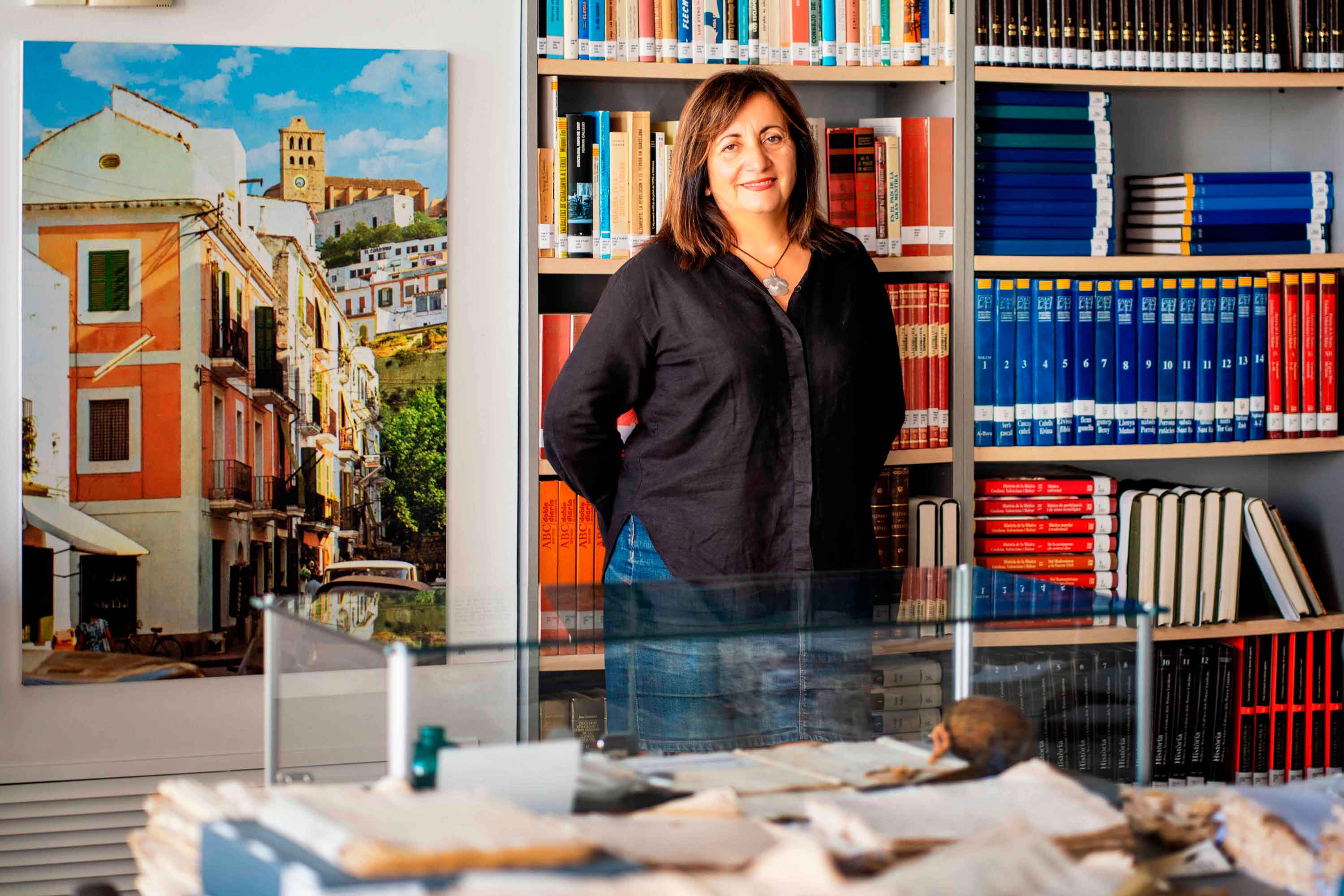
Marisa Llopis Company began working in the call centre at Baleària as summer cover in May 2000, as the role allowed her to balance work with family life.
Today, she still works at the head office in Dénia as a purchasing technician; many things have changed over the years, but not her ever-present smile.
When Baleària was taking its first steps as a company, the Dénia headquarters became a growing workplace, particularly its call centre, which at one point employed more than one hundred people, mostly women. These were the days when online sales still seemed like a pipe dream. Like many others, Marisa Llopis submitted her CV to Baleària through word of mouth.
With no experience in the sector, Marisa Llopis took on the challenge with her characteristic positivity: “When they hired me, I couldn’t believe it. You could say I’m at Baleària thanks to Carol Ramis [one of the company’s long-standing employees; at Flebasa from 1993 and, since Baleària was founded, a member of Baleària’s accounting team], who told my cousin that they needed people for the summer season. I don’t think I’ve ever actually told Carol this, so I’d like to take the opportunity to thank her here. I started in the call centre providing information and taking bookings over the phone, but just two months later my manager, Cristina Mulet, asked whether I’d be interested in working at the ticket office because they needed someone, and I accepted.”
Since that now-distant May 2000, Marisa Llopis spent just two months in the call centre, moved to the ticket offices for 10 years and finally joined the Purchasing department, which is governed by the ethical principles that form one of Baleària’s defining characteristics.
Marisa Llopis’s natural optimism means she recalls with real enthusiasm several milestones in the company’s history, such as the entry into service of the “majestic” Federico García Lorca (which she says she was very sad to see sold), or following the Eleanor Roosevelt as it left the shipyard, made its crossing and arrived in Dénia, an experience she describes as “very exciting”. She does not, however, have a favourite ship or company milestone: “I’ve always shared in Baleària’s good moments with great enthusiasm. Every new ship that has been built, every new route that has opened, the construction of the ferry terminal where we are now…”
It is precisely this positivity that makes Marisa Llopis a valuable witness to Baleària’s more difficult moments, which, as in any organisation, have certainly occurred: “I remember the 2008 financial crisis, when Baleària had taken on debt for four new ships. At that year’s Christmas dinner, things were looking very bleak and Adolfo said so at the start of the evening, but he also told us that he did not intend to let anyone go and added that, if we got through the situation, we would do it together. And that is exactly what happened: we got through it thanks to everyone’s efforts.”
Another such episode came during the pandemic [when Baleària maintained the salaries of employees subject to an ERTE furlough scheme]; Marisa Llopis remembers being at home watching online the president’s message: “Until that moment, I had never seen him look so downcast. It made me incredibly sad and I thought it was the end of Baleària. I couldn’t hold back the tears… I kept wondering how a company that was doing so well at the time could collapse because of a virus. But fortunately, we got through that as well.”
“Baleària is where it is today because of the courage of our president. Nothing ventured, nothing gained, and he has known when to take risks and how to surround himself with effective people and departments that have been able to adapt, modernise and avoid being left behind. We have not been afraid to build new ships, convert several vessels to natural gas, open new routes that represented major challenges, such as the US route, or invest in technology and digitalisation…,” says Llopis. Most importantly, she stresses, society must see Baleària as a serious, responsible and trustworthy company: “We will continue to grow because we are unstoppable.”
Having started out handing passengers cardboard boarding cards stamped by hand, and then having to recount the stubs collected by the crew in order to draw up the passenger list, gives Marisa Llopis a perspective from which she says she barely recognises “the Baleària of those days compared with the Baleària of today, apart from the team spirit and shared goals”.
From this perspective, she also recalls positive moments of interaction with customers: “One day, when I was feeling a bit low for personal reasons, I was told that some customers were asking for me by name at the ticket office. I was worried, but it turned out they were looking for me so they could give me two ensaimadas as a thank-you for a problem I had solved for them a year earlier. I shared one with my colleagues and the other with my family, and it completely turned my day around.” After telling the story, Marisa Llopis wonders whether, under the ethical rules that govern the company today, she would have been able to accept the ensaimadas.
 X
X