
 English
 Spanish
 Catalan
 French
 Italian

Pedro Puertas (San Fernando, 1965) is one of the captains who witnessed the birth of Baleària in 1998.
After studying Nautical Science and Naval Engineering, he nearly opted for a job ashore, but “the prospects for the future” convinced him to go to sea. After serving as a cadet with different companies and completing his military service in the Navy, he joined Flebasa, Baleària’s predecessor, in 1994, where he remembers finding “a group of people full of enthusiasm and eager to progress”. Puertas reflects on what these 25 years of history have meant to him.
Q. What surprised you most when you were starting out?
A. From the very beginning, I was won over by the friendly atmosphere. Your voice was heard and you always felt part of the group. That has remained a constant. If you show even a little interest, Baleària gives you the opportunity to develop and take on greater responsibilities.
Q. Those 25 years must have involved a great many voyages.
A. I have experienced many interesting moments in the company’s history. The construction of the Lorca in Italy and its entry into service; launching routes to Tangier and Ceuta; the construction of the Martín i Soler and the Alhucemas in Galicia; crossing the Atlantic on the Alhucemas to convert it into the Bahama Mama and trying to export the ferry model to the Bahamas service; the construction of the Hypatia de Alejandría in Italy; helping to fine-tune the operation of the Eleanor Roosevelt... and whatever is still to come, because I am sure there will be something new.
Q. What have been the most difficult moments in Baleària’s history?
A. Setting up the shipping company was the first difficult moment. We had to prove that we were a serious company, that we were here to stay and that we were going to give it our all. I believe we have gradually demonstrated all of that through our actions. Another difficult time was the 2008 crisis, which for me coincided with the construction of new ships. We realised that data management and resource control could make all the difference to our future.
Q. And your best memories?
A. I have so many, but I think the arrival of the Lorca and the change we experienced in our day-to-day work as we pursued service excellence was a challenge that absorbed, enveloped and captivated us. It was hard, but incredible.
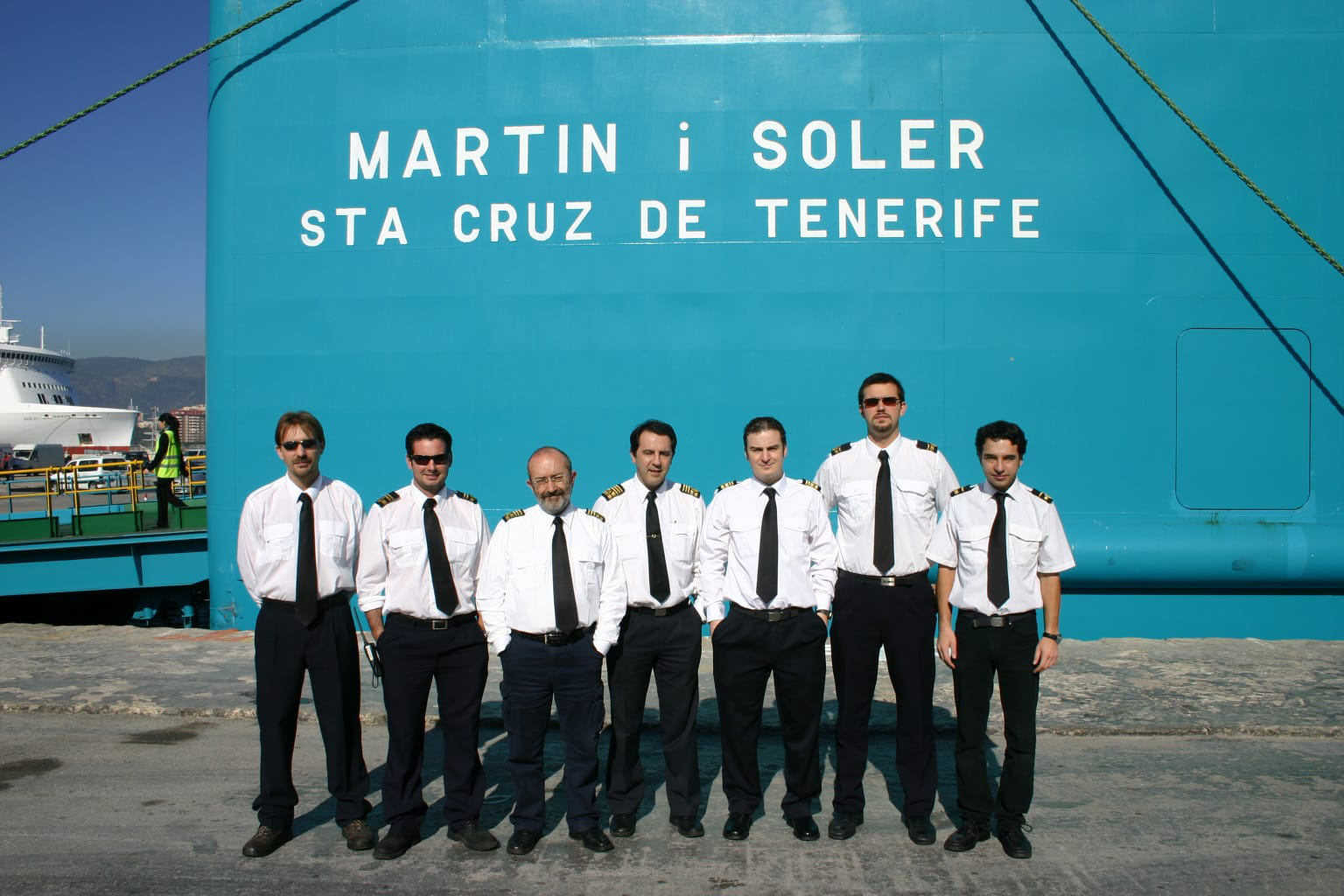
Pedro Puertas as captain of the ferry Martín i Soler
Q. How have you experienced the company’s evolution?
A. Always with great enthusiasm, although I admit that at times I have thought we were a little crazy for taking on the “impossible” projects our president urged us to pursue. If we had been led by someone more willing to settle for the status quo, we would not be where we are today. On top of that, we are a team of people prepared to give it their all to make these projects a reality.
Q. Tell us an anecdote that illustrates how technology has evolved.
A. When I started, the Bahía de Málaga did not have GPS; there was a radio officer who used Morse code and, although there was a mobile phone on board, it was analogue and larger than a shoebox. We had a computer, but we did many things with a typewriter and carbon paper for copies. Today, we only have to look at our projects involving gas, electric propulsion or hydrogen to see that Baleària is always looking to the future, which means we must keep evolving and learning. In addition, we are making increasing use of data to optimise management at every level.
Q. Looking back, what do you think Baleària has given you?
A. Both personally and professionally, Baleària has been the thread running through my life. It has enabled me to develop professionally, which in turn has allowed my personal life to remain stable. However, because it is such a dynamic company, I have never had time to become bored or stagnate.
Q. And what do you think you have contributed?
A. I have always tried to give the best of myself while creating a pleasant working environment. I have loved teaching and learning from the people around me, and encouraging them to take ownership of their responsibilities. I hope they remember me as a colleague who tried to make them feel part of the team, comfortable in their work and recognised for their growth and development.
Q. What does working on a ship involve?
A. Working on board means ensuring, whatever your role and level of responsibility at any given time, that the vessel’s operation is finely tuned so the vessel runs as efficiently as possible for the company.
Q. Tell us about an element you consider key to Baleària’s success.
A. Baleària has reached its current position primarily by drawing on its own talent. Caring for, valuing, training and developing our people will create the commitment needed to nurture talent from within, enabling us to face the future on solid foundations.
 X
X